The thesis
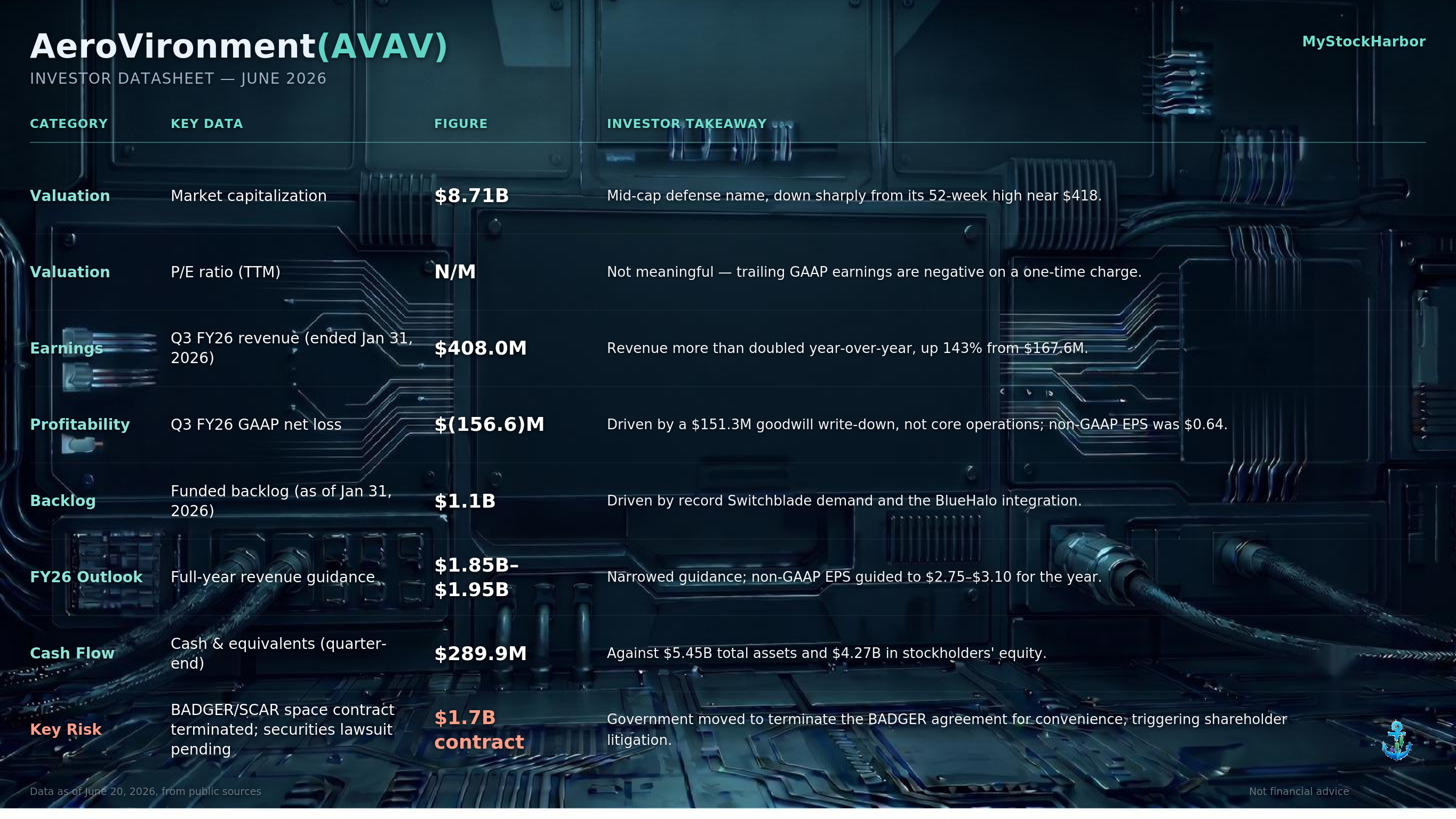
AeroVironment has spent 20 years quietly tearing down the cost barrier to precision strike capability. The market still prices it like a reconnaissance drone company. It isn't. AVAV now sells the weapon itself — the Switchblade loitering munition — and has expanded into directed energy, space communications, and cyber through the March 2025 BlueHalo acquisition. In under 12 months it evolved from a single-product drone shop into a four-domain defense platform covering Air, Land, Space, and Cyber.
The stock is dislocated. It is pricing in a temporary wound from a single canceled space contract while ignoring an unprecedented defense backlog building underneath. Q4 earnings on 29 June and an investor day on 8 July are the two events that will force the market to reassess.
Key numbers
- Q3 FY26 revenue: $408M — up 143% year-over-year from $167M
- GAAP net loss: $156.6M — entirely driven by a one-time $151.3M goodwill impairment on the BADGER/SCAR program; the core business was not the cause
- Non-GAAP EPS: $0.64 — positive underlying profitability, adjusted EBITDA more than doubled to $44.5M (from $21.8M a year earlier)
- Funded backlog: $1.1B as of 31 January 2026 — nearly 7× the company's entire annual revenue from just three years ago
- Total contract ceiling: $3.5B (funded and unfunded combined)
- FY26 revenue guidance: $1.85B–$1.95B
The setup
The Switchblade is the core of the thesis. It is not a reconnaissance drone — it is a loitering munition: a tube-launched aircraft that deploys, surveys the battlefield, and gives the operator a live video feed and a real-time decision to strike, abort, or retarget. A human makes the final call. That human-in-the-loop design is what separates it from a traditional missile and why global demand is accelerating. The Switchblade family now covers close-in strikes (300 Block 20), long-endurance anti-armor (600 Block 2), and AVAV has already demonstrated launching a Switchblade 600 from an MQ-9A drone via satellite control.
The BlueHalo acquisition adds directed energy weapons and advanced space communications — allowing AV to sell not just a weapon but the entire interconnected kill chain. A modern engagement might need a Switchblade strike, a laser knocking out an incoming drone swarm, and a space-based comms link relaying data to command — all within 90 seconds. AVAV is positioning to supply all three.
At the time of the video, the stock was trading near multi-year lows around $163 — a compression driven by the BADGER/SCAR contract termination and the class action lawsuits that followed, not by any deterioration in the autonomous systems business.
Risk factors
- BADGER/SCAR contract lost: The Space Force terminated the contract for convenience and shifted to a multi-vendor, commercial off-the-shelf model. AV will have to recompete. Space segment revenue is structurally impaired.
- Class action litigation: Multiple law firms filed suits covering June 2025–March 2026, alleging AVAV misled investors on SCAR viability. Lead plaintiff deadline 27 July 2026 — keeps institutional buyers cautious near-term.
- Financial restatement: Q3 results were restated after an error in goodwill valuation tied to deferred tax items. Arriving during a CFO transition, this hurt confidence in financial controls.
- Autonomous strike ethics and regulation: The CEO has noted the technology already exists for Switchblade to operate without a human confirming the target. Whether that changes is both a strategic wildcard and a regulatory risk that could reshape the product's positioning.
What to watch
Two dates define the near-term setup. On 29 June 2026, AVAV reports full fiscal year 2026 earnings — the first complete look at how the Switchblade surge and BlueHalo integration are performing together. On 8 July 2026, management hosts an investor day in New York City to lay out the next phase of the growth strategy. If Q4 revenue meets or exceeds guidance and management shows a credible FY27 path built on the drone business rather than space, the stock has significant room to re-rate — 15 analysts still have buy ratings with an average target above $300. If either event disappoints, the $155 area is the line in the sand.